Shared-prefix tree scorer
Status: current
The tree is the architecture of selfjev-4b, the default model; its Qwen3.5 version is
src/selfjev/engine/tree.py (below). The rest of the page
measures the first tree, on Qwen3 (2026-09-23), whose code is archived at tag archive/pre-cleanup-2026-09-27.
The text is read once, and every question and candidate still reads it through all of the model's layers, in one forward pass with no text generation. It combines what we measured separately:
- the stock reranker's joint reading of text and question (accurate, but it re-reads the text for every candidate; see stock_model.md);
- the custom model's shared text encoding (fast, but text and question met only in 2 small layers at the end, and yes/no questions stayed at chance; see custom_model.md).
Code: the Qwen3 tree of these runs is at tag archive/pre-cleanup-2026-09-27 (tree.py,
train_tree.py, tests/test_tree.py); the Qwen3.5 tree of
selfjev-4b is src/selfjev/engine/tree.py (training and TreeServer), tests in
tests/engine/.
Later results. The measurements below are the first tree runs (round-1 data, dev benchmark, 2026-09-23). Every later best model is a tree too: round-2b data 90.6% on eval2, all options in the question 91.6%, Qwen3-4B-Instruct-2507 + LoRA r64 + round-2 data 92.7%, then Qwen3.5-4B with its own tree:
qwen35_4b_tree95.6% andselfjev-4b95.8% (Jev 97.2%). The Instruct base, weaker here on the dev benchmark, is +3.0 on eval2. See the leaderboard and key findings.
Bottom line (Qwen3 tree; dev benchmark = the 3,471-question test split; 2026-09-23, one AWS A10G, bf16). - Qwen3-Reranker-4B + LoRA in the tree format scores 81.6%. On the same data with the same LoRA settings, the stock 4B scores 80.3% (p = 0.016) and the stock 8B scores 80.7%. Jev scores 82.7%; the gap is not significant (p = 0.08). - It is up to 32–37× faster than the stock 4B when there are several questions per text: 16 questions × 3 candidates take 2.8 s instead of 90.4 s on an 8K-token text, and 5.6 s instead of 207 s on a 16K-token text. With a single question, both take the same time. - The reranker is the better base once fine-tuned. Qwen3-4B-Instruct-2507 was ahead before training (72.0% vs 66.9% on validation) but scores 80.4% on the dev benchmark after LoRA, vs 81.6% (p = 0.016).
What is computed
[instructions + <Document>: text] ─┬─ [<Instruct> … Question: q1 … Proposed answer:] ─┬─ [" candidate A" + suffix] → z_yes − z_no
                                   │                                                  └─ [" candidate B" + suffix] → z_yes − z_no
                                   └─ [… Question: q2 … Proposed answer:] ─────────────── [" Yes" + suffix]     → z_yes − z_no
- One token tree per distinct text. A tree attention mask lets each token see its own segment (causally) and its ancestors, and never a sibling. Position ids continue from the parent.
- Exact pairwise semantics. Each leaf scores exactly like the standalone causal sequence
instructions + text + question + candidate, i.e. the stock reranker's pairwise judgment with the text moved first so it can be shared.tests/test_tree.py(at the tag) checks this against standalone runs: 1e-4 on a tiny model, 1.7e-5 on the real 0.6B reranker. Extra questions and candidate order cannot change an answer, and a test checks that too. - Two execution paths, both exact:
packed(training): one pass over the whole tree with a [T, T] mask.cached(inference): the text alone with the plain causal kernel into a KV cache, then all branches in one second pass against that cache. The text costs one pass however many questions there are.- Readout.
s = z_yes − z_noat each leaf's last token, then the samedecideas every backend (nowselfjev.core.answers.decide): sigmoid for binary, softmax within a question for multiclass, per-candidate sigmoid for multilabel. - Format
tree-v1. It is the stockanswer-v1mapping (the one validation selected for the 4B reranker) with the text first. Template pieces are tokenized with their control tokens; user text is tokenized withsplit_special_tokens, so<|im_end|>inside a text stays plain text. The reranker uses its official assistant suffix; instruct models use<|im_end|>\n<|im_start|>assistant\n. The format sha is recorded in every report. - Backbones. Any Qwen3-architecture causal LM works. Hybrid models were out at first (Qwen3.5 was solved later, below):
- Qwen3.5 makes 3 of every 4 layers recurrent (linear attention), which cannot keep branches isolated in one pass.
- Gemma-4-E4B uses 512-token sliding windows in 5 of 6 layers.
Results
Sources: reports/<run>/test/report.json; Jev and GPT-6 Astra from reports/external/full/.
| dev benchmark, 3,471 questions | stock 4B | stock 4B + LoRA | tree 4B + LoRA | tree Instruct-4B + LoRA | stock 8B + LoRA | Jev | GPT-6 Astra |
|---|---|---|---|---|---|---|---|
| run | baseline_4b |
lora_4b |
tree_4b |
tree_4b_instruct |
lora_8b |
||
| question accuracy % | 62.8 | 80.3 | 81.6 | 80.4 | 80.7 | 82.7 | 85.8 |
| binary AUROC | 0.604 | 0.945 | 0.953 | 0.958 | 0.945 | 0.981 | 0.971 |
| multiclass accuracy % | 76.2 | 82.3 | 83.9 | 82.3 | 82.9 | 84.6 | 87.0 |
| multiclass macro-F1 % | 83.4 | 86.2 | 89.7 | 87.1 | 88.7 | 91.6 | 95.3 |
| multilabel exact match % | 2.0 | 47.7 | 51.7 | 46.8 | 48.0 | 40.1 | 55.8 |
| multilabel micro-F1 % | 25.1 | 73.6 | 74.9 | 71.5 | 72.1 | 66.3 | 74.0 |
Paired exact McNemar tests on the same questions (questions only one of the two gets right):
| comparison | tree 4B only | other only | p |
|---|---|---|---|
| tree 4B vs stock 4B + LoRA | 182 | 138 | 0.016 |
| tree 4B vs tree Instruct-4B | 175 | 132 | 0.016 |
| tree 4B vs Jev | 217 | 256 | 0.08 (not significant) |
| tree 4B vs GPT-6 Astra | 150 | 297 | 3e-12 |
Validation (868 questions, the split used for model selection), before and after LoRA (reports/<run>/validation/;
the untrained tree rows are reports/tree_zeroshot_{reranker,instruct}_4b/, at the tag):
| untrained | + LoRA | |
|---|---|---|
| stock Reranker-4B, pair format (text last) | 54.4% | 77.5% |
| tree, Reranker-4B (text first) | 66.9% | 78.0% |
| tree, Qwen3-4B-Instruct-2507 | 72.0% | 77.9% |
Putting the text first helps the untrained reranker by 12.5 points. After LoRA, both tree backbones are close on validation, and the reranker wins on test.
Accuracy % by family (selected; all families are in each report):
| family | stock 4B + LoRA | tree 4B | tree Instruct-4B | Jev |
|---|---|---|---|---|
| eval_adversarial | 81.5 | 96.3 | 81.5 | 100.0 |
| eval_urgency_sentiment | 68.2 | 90.9 | 81.8 | 95.5 |
| eval_agent_output | 53.8 | 61.5 | 57.7 | 92.3 |
| heldout_question_type_trec (unseen) | 76.3 | 88.7 | 90.3 | 94.0 |
| heldout_intent_clinc (unseen) | 93.0 | 94.7 | 91.3 | 94.3 |
| heldout_boolq (unseen) | 83.3 | 83.3 | 83.0 | 90.7 |
| heldout_sentiment_sst2 (unseen) | 88.0 | 84.0 | 86.0 | 96.7 |
| hf_nli | 92.3 | 94.3 | 94.3 | 92.7 |
| hf_emotions_multilabel | 46.7 | 49.7 | 43.3 | 31.7 |
Speed
Setup.
- One AWS A10G (g5.xlarge), bf16, same session. Both models run the 4B reranker with an unmerged LoRA adapter.
- End-to-end p50 latency, one request at a time.
- Sources: reports/bench/gpu_{tree_4b,stock_lora_4b}_bf16/ and …_long_bf16/; environment in
reports/bench/gpu_tree_environment.txt (driver 595.91.07, torch 2.14.0+cu130, transformers 5.17.0).
| text tokens | questions × candidates | stock 4B + LoRA | tree 4B + LoRA | speed-up |
|---|---|---|---|---|
| 512 | 1 × 3 | 375 ms | 192 ms | 2.0× |
| 512 | 16 × 3 | 5,414 ms | 686 ms | 7.9× |
| 2,048 | 1 × 3 | 1,299 ms | 526 ms | 2.5× |
| 2,048 | 16 × 3 | 20,460 ms | 1,091 ms | 18.8× |
| 2,048 | 16 binary | 7,176 ms | 712 ms | 10.1× |
| 8,192 | 1 × 3 | 5,657 ms | 2,012 ms | 2.8× |
| 8,192 | 16 × 3 | 90,449 ms | 2,798 ms | 32.3× |
| 16,384 | 1 binary | 4,324 ms | 4,483 ms | 1.0× |
| 16,384 | 16 × 3 | 206,915 ms | 5,638 ms | 36.7× |
| 32,000 | 16 × 3 | — | 14,235 ms (14.7 GB peak) |
- Where the time goes. The stock model pays pairs × text tokens. The tree pays for the text once, plus a short branch per question and candidate, so adding questions barely changes the time.
- Single-candidate speed-ups. Even with one question × 3 candidates, the stock model reads the text 3 times, hence the 2–3× gain.
- Absolute latency is A10G-bound; see the end-to-end comparison with Jev below.
End to end vs Jev (A10G, 2026-09-23)
The same decisions-API requests were sent from a Mac in California to both services, one at a time: - Jev through OpenRouter, whose edge is 7–13 ms away; - ours (tree 4B + LoRA) on one AWS A10G in us-east-1, 71 ms away.
The table gives p50 wall times at the client, text 8 → 4,096 tokens, choice questions with 3 options: ours over 10
timed rounds; Jev pooled over the 5 sweep runs of 2026-09-23 to 09-26 (50 samples per cell; the 2026-09-23 runs alone
gave 143–178 ms, per the JOURNAL). Full tables, p95, server-side times and cost:
reports/latency/summary.md; script scripts/latency_sweep.py and chart
scripts/latency_chart.py, both at the archive tag.
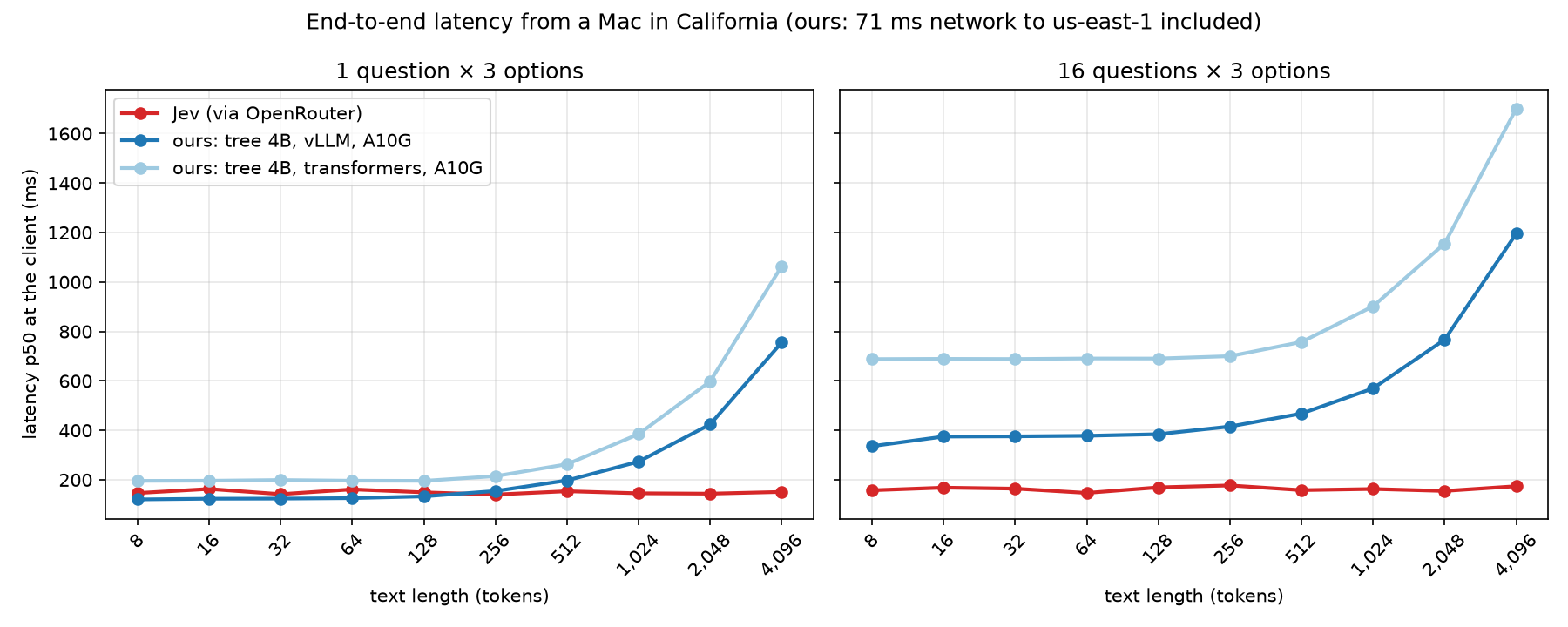
| text tokens | Jev, 1 q | ours vLLM, 1 q | ours transformers, 1 q | Jev, 16 q | ours vLLM, 16 q |
|---|---|---|---|---|---|
| 8 | 129 ms | 120 ms | 196 ms | 139 ms | 336 ms |
| 512 | 135 ms | 197 ms | 263 ms | 144 ms | 467 ms |
| 2,048 | 129 ms | 424 ms | 598 ms | 152 ms | 767 ms |
| 4,096 | 139 ms | 755 ms | 1,062 ms | 155 ms | 1,195 ms |
- Jev's curve is flat. Its compute for ~6K tokens takes tens of ms, so its time is mostly network and API overhead.
- Ours scales with the text. The A10G is compute-bound at 6.5–10K tokens/s with vLLM and 4.7–6K with transformers.
- Cost. Fully busy at $1.006/h, the A10G with vLLM costs $0.005–0.27 per 1,000 requests; Jev costs $0.016–0.27 at $0.042 per million input tokens. We are cheaper only while the GPU is busy.
- vLLM backend (vllm_tree.py, archived):
- every leaf is one prompt, and the prefix cache shares the text between leaves;
- the LoRA is merged into the weights;
- on the example request it makes the same decisions as the transformers path, scores within 0.06 logit;
- its test-set accuracy has not been re-measured.
Training
Sources: the training logs reports/train_meta/tree_4b.json and reports/train_meta/tree_4b_instruct.json; configs
configs/tree_4b*.json at the tag.
- Data: the same 10,112 training questions as every other run (seed 13, at most 1,600 per family), with 983
validation questions.
- LoRA: r = 16 on q/k/v/o (11,796,480 trainable parameters), lr 2e-4, 5% warm-up, 1 epoch, bf16, gradient
checkpointing.
- Micro-batches: each holds whole trees (one per text, with all its questions), 16,384 padded tokens,
gradient accumulation 2.
- Runs:
- Reranker-4B: 84 steps in 37 min; best validation loss 0.321 at the last step (stock 4B LoRA: 0.338).
- Instruct-4B: 78 steps in 35 min; best validation loss 0.338.
- Checkpoint reload: exact (0.0 difference) for both.
Calibration
The held-out temperatures are about 1 (binary 1.02, multiclass 1.06, multilabel 0.99; calib/tree_4b.json at the
tag), so the raw scores are already calibrated: binary ECE 0.077, multiclass 0.029, multilabel 0.017
(reports/tree_4b/test/). The thresholds chosen on validation lower test accuracy from 81.6% to 79.3%
(reports/tree_4b/test_calibrated/), so tree_4b was served without the calibration file, with the default 0.5
thresholds.
Qwen3.5 (hybrid DeltaNet)
Qwen3.5-4B is three Gated DeltaNet layers (a gated linear recurrence with a width-4 causal convolution) for every
full-attention layer. A tree mask cannot hide one branch from its siblings inside a recurrence, so
selfjev/engine/tree.py runs the same packed tree two ways:
- Full-attention layers read the packed row through
tree_mask, exactly as above. - DeltaNet layers run level by level: every root; then every question segment, starting from its root's final recurrent state and last three convolution inputs; then every leaf, starting from its question's. Gradients flow back through those copied states. Right padding inside a level leaves the state untouched (q = k = v = 0, beta = 0, g = 0).
Every leaf equals its standalone sequence (root + question + leaf). tests/engine/test_tree.py checks scores and every
gradient against full sequences on a tiny random model in fp32. On the real model, fp32 scores agree within 0.004 and
LoRA gradients at cosine 0.99997; in bf16 the tree is as close to full sequences as full sequences are to themselves
re-batched (reports/qwen35_4b_tree/checks/). Token ids are Qwen35Scorer.entry's
(selfjev/engine/qwen35.py). The first Qwen3.5 adapters were served by forking the
model's native cache (archived); on master TreeServer serves with the same tree, forward only (the text once per
request, each question once, then each candidate; on GPU it gives the old engine's answers on all three test sets,
JOURNAL 2026-09-27 11:55), and vLLM serves the merged adapter with its prefix cache
(selfjev/engine/vllm.py).
Training with it (run_qwen35.py --tree at the time, selfjev finetune now) encodes each text once per state instead
of once per candidate. For qwen35_4b_tree, texts up to 8K tokens fit, 51.8K questions in 4.1 h on one L40S, where
full-sequence training (qwen35_4b_combo) had to drop 18.5% of the data at 2K tokens and took 6.6 h
(reports/train_meta/qwen35_4b_tree.json, qwen35_4b_combo.json); it scores 95.6 on eval2 against 94.5 without the
tree (JOURNAL 2026-09-25). selfjev-4b is the same tree trained from scratch on 79,943 questions with
texts up to 16K tokens: eval2 95.8, eval_llm 93.1 (weights/selfjev_4b/model.json).
Limitations
Of the Qwen3 tree runs above:
- One seed and one hyperparameter setting per backbone.
- The 81.6% vs 80.3% gain over stock is significant (p = 0.016) but modest.
- Speed on this page is one A10G (the L40S was out of capacity then); L40S and H100 numbers came later (speed).
- The dev benchmark's caveats apply (data): LLM-written
eval_*families with 17–32 questions each, and possible pretraining overlap of the public sets. - Remaining gap to Jev and GPT-6 Astra then: sarcasm and sentiment (SST-2 84.0 vs Jev 96.7), BoolQ (83.3 vs 90.7),
and judging AI replies (
eval_agent_output, 61.5 vs 92.3).
Reproduce
The current tree: uv run pytest tests/engine on master (scores and gradients equal full sequences, the tree server);
training with selfjev finetune (fine-tune); the selfjev-4b recipe is
scripts/train/selfjev_4b.sh.
The Qwen3 tree, from a checkout of tag archive/pre-cleanup-2026-09-27
(package personal_jev, CLI pjev). Its adapters were not kept, so train one first:
uv run pytest tests/test_tree.py                              # the last 2 tests load the real 0.6B reranker
uv run pjev train-tree configs/tree_4b.json                   # CUDA GPU: LoRA -> runs/tree_4b/adapter
uv run pjev classify examples/request.json --tree --model Qwen/Qwen3-Reranker-4B \
  --revision 22e683669bc0f0bd69640a1354a6d0aebcfeede5 --adapter runs/tree_4b/adapter --dtype bfloat16
The GPU pipeline of these runs (scripts/run_tree_gpu.sh: untrained check, LoRA x2, evals, benchmarks) is at the same
tag.